


Irvine - Explore a medieval New Town
St Inan's Well, Sacred Spring
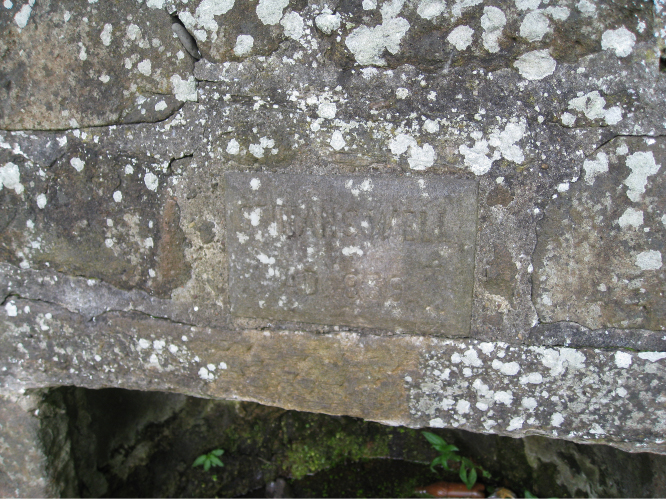
This spring was dedicated to St Inan, Irvine's patron saint; there was also an altar in the parish church dedicated to him. Above the spring is a stone tablet with the inscription "St Inans Well AD839" which was re-incised by an unknown person in May 1921.
Inan is quite an obscure saint and his name has two possible sources. According to Thomas Clancy of the University of Glasgow the famed Ninian was a name derived from Uinniau (a sixth century Briton missionary). Over the centuries the name transformed in different parts of Scotland and local cults arose and he became known as Winnin, Fillan, Finan and perhaps our Inan.
Thorbjorn Campbell suggests that there may have been a Brythonic version of the Irish hero Fionn mac Cumhaill venerated here in pre-Christian times. The practice of the early Christian church of renaming local deities as saints could have given us Inan.
Other nearby sites have associations with the saints' names. Kilwinning, meaning church of Winnin, was an important pilgrimage site and Norman abbey. The chapel of Dundonald Castle was dedicated to Ninian and used by the early Stewart kings. St Fillan’s Well near Skelmorlie, now no longer in existence, may have had a chapel as well. Southannan at Fairlie is a corruption of Saint Inan.
The cult of Inan seems to have been strongest in Beith with St Inan's Well and Chair up in Lochlands Hill, indeed Beith's annual fair is St Inan's Day. Even today the people of Beith tell stories of Inan visiting the area.
Useful websites


Back to the Irvine Trail
